
Sovereign AI Driving Innovation: TAIWAN AI RAP and TAIDE Showcase Application Achievements Across Industries to Co-Create a Smart Taiwan
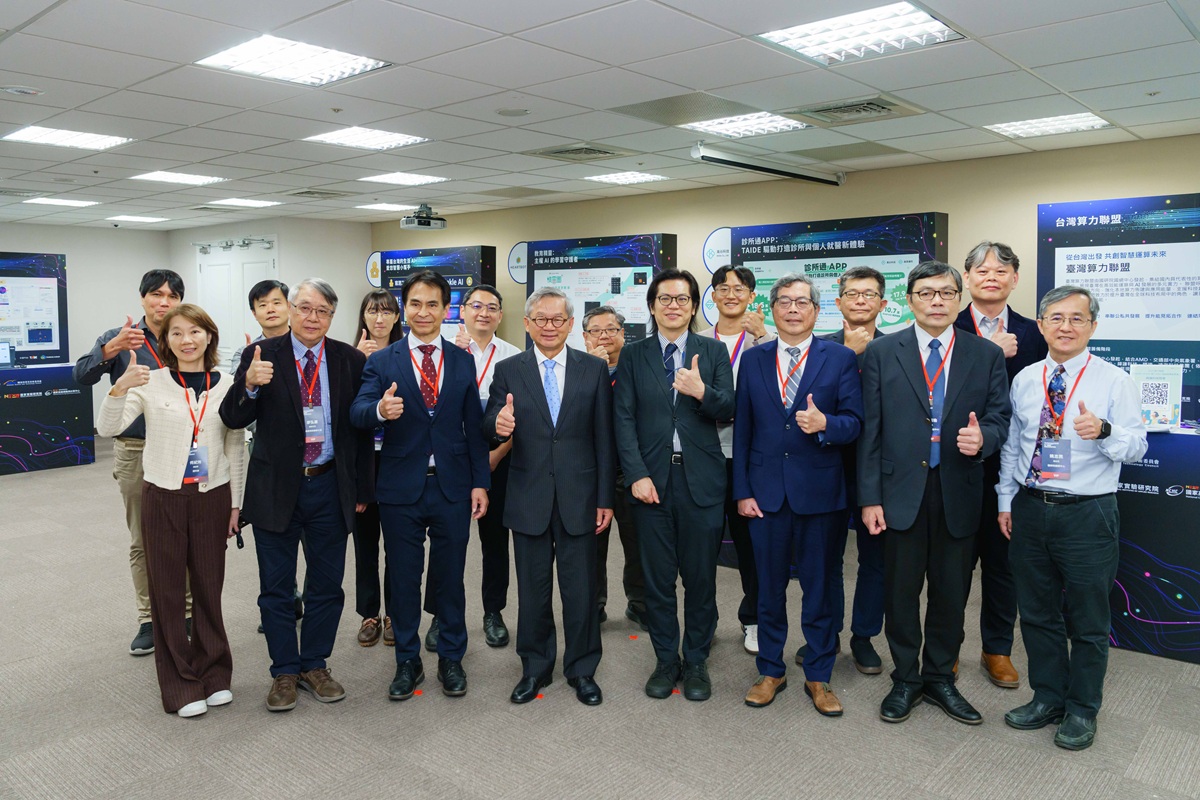
Generative AI is reshaping the global industrial landscape at an unprecedented pace. From finance, education, and healthcare to manufacturing, countries around the world are accelerating the deployment of localized AI strategies to safeguard data sovereignty and strengthen innovation competitiveness. In response to this challenge, the National Science and Technology Council (NSTC) is advancing its vision of “Sovereign AI” through domestically developed AI technologies. Under its jurisdiction, the National Center for High-performance Computing (NCHC) of the National Applied Research Laboratories (NARLabs) held the “TAIWAN AI RAP & TAIDE Highlights Showcase” on November 11, themed “Sovereign AI Driving Innovation: Co-Creating a Smart Taiwan Across Industries,” presenting the latest achievements and application cases of localized generative AI development.
The showcase attracted enthusiastic participation from government, industry, academia, and research communities. In his opening remarks, NSTC Minister and Chair of NARLabs, Wu Cheng-Wen, stated that the government is actively promoting the “New Top 10 AI Infrastructure Projects,” guided by three major pillars: digital foundations, key technologies, and intelligent applications, to comprehensively accelerate Taiwan’s transition into a smart nation.
The digital foundation pillar focuses on computing infrastructure, data governance, and sovereign AI, promoting regional balance, software-hardware integration, and talent development. Intelligent applications emphasize the growth of the AI software industry, the adoption of AI tools across all sectors, and the creation of a smart living ecosystem for all citizens—ensuring AI is truly embedded in industry and everyday life. He emphasized that NCHC plays a pivotal role in this national initiative as the core provider of computing power, a localized AI R&D platform, and a driver of cross-domain applications, offering solid support for industrial upgrading and social innovation in Taiwan.
Cross-Domain Achievements Demonstrating Localized AI Innovation
The “TAIWAN AI RAP & TAIDE Highlights Showcase” brought together a wide range of flagship applications, fully demonstrating the deep integration of Taiwan’s AI technologies with local needs. From healthcare, education, and agriculture to enterprises and daily life, the event highlighted the real-world impact and innovative potential of the TAIWAN AI RAP platform and the TAIDE language model across multiple domains.
In healthcare, CEO Liu Hsin-Cheng of G-Easy Information integrated the TAIDE model to launch the “ClinicPass App,” an intelligent search system that accurately matches clinic services through natural language queries, enhancing patients’ healthcare experiences. At Kaohsiung Veterans General Hospital, Dr. Lin Po-Hsiang leveraged the RAP platform to develop the “ER-Pulse Intelligent Handover Platform,” automating emergency department shift handovers and reducing processes that once took several minutes to just seconds—an exemplary case of generative AI successfully adopted in clinical practice.
In education, Heartbot AI CEO Yan Tzu-Chiang presented an AI teaching assistant platform powered by the TAIDE model, emphasizing secure deployment, contextual understanding, and the integration of local values into smart education. In agricultural technology, Hung Yu-Ting, Section Chief at the Agricultural Technology Research Institute, introduced “Pig Matters AI,” enabling farmers to query pig health information and environmental data via simple text or voice input, significantly improving efficiency and usability—demonstrating tangible outcomes in smart livestock farming.
Within enterprise applications, CEO Lin Chih-Che of Systex Smart Technology showcased the “ShareQA AI Knowledge Management Customer Service Platform,” featuring domestically developed agentic AI technology and integration with TAIDE and other small language models (SLMs). The platform provides SMEs with a low-barrier SLM solution to adopt AI, enhancing knowledge management and service efficiency while accelerating digital transformation—serving as a benchmark for industrial upgrading.
On the R&D front, the AI Research Center at National Yang Ming Chiao Tung University unveiled “myPDA,” a fully on-premises GenAI system that creates AI avatars with contextual understanding. Its core technology, the “Context Transformer,” accurately identifies Traditional Chinese expressions and semantic nuances, optimizing responses and reinforcing Taiwan’s linguistic sovereignty.
Additionally, the Twinkle AI community collaborated with Chen-Si Studio to develop Taiwan’s first minimal-reasoning model using the platform, while Chen-Si Studio also introduced “Aiyo Helper,” a lifestyle-oriented application built on the same platform.
NCHC further showcased its collaboration with the National Science and Technology Center for Disaster Reduction in upgrading the “Rainfall Helper App” with an AI Firefly weather Q&A feature, as well as the Science and Technology Policy Research and Information Center (STPI) presenting iVoice, a personalized voice-based intelligent agent capable of rapid speech-to-text conversion, AI analysis, and interactive dialogue.
Collectively, these成果 illustrate the deep fusion of generative AI with diverse application scenarios and reflect Taiwan’s progress in AI sovereignty, industry co-creation, and intelligent applications, marking a critical step toward becoming an AI-driven technology island.
Connecting Industry and Research to Expand the Generative AI Ecosystem
The event also featured keynote speeches and technical insights from prominent speakers. Jiang Meng-Hsuan, Manager of the FinTech Industry Alliance, opened with “A New Era of FinTech: The AI-Driven Financial Future,” sharing how generative AI will reshape digital finance and unlock new innovation potential.
Huang Han-Hsuan, Associate Research Fellow at Academia Sinica’s Institute of Information Science and a key partner in TAIDE model development, delivered a keynote titled “The Path to Autonomous Language Model Technology,” discussing the evolution of large language models, TAIDE’s localized training achievements, and international comparisons. Multiple themed talks and exhibition booths further showcased real-world generative AI applications across industries.
NARLabs Vice President Lin Chun-Liang noted that by integrating its research capabilities, NARLabs is building a cross-industry, academia, and research service platform to drive AI technologies from fundamental research to industrial deployment. Looking ahead, NCHC will continue strengthening the integration of generative AI and high-performance computing (HPC), expanding an application ecosystem centered on the TAIDE model, and bringing AI innovation into key sectors such as education, healthcare, and manufacturing—advancing Taiwan toward a smarter and more sustainable future.
NCHC Director Chang Chao-Liang emphasized that breakthroughs in generative AI have prompted a global reassessment of the importance of AI sovereignty and technological control. This showcase focused on the latest成果 of two core platforms—the high-performance AI application development platform TAIWAN AI RAP and Taiwan’s trusted AI conversational engine TAIDE—demonstrating Taiwan’s phased progress in autonomous computing, AI platform technologies, and ecosystem integration. Looking forward, NCHC will continue enhancing RAP’s capabilities, expanding TAIDE’s application potential, and promoting the autonomous integration of AI computing power and platforms, helping industries embrace AI innovation in a secure, trustworthy, and sustainable manner. Minister Wu Cheng-Wen of the National Science and Technology Council Visits the Heartbot AI Exhibition Booth