
Integrating the TAIDE Local Language Model: Heartbot AI Builds a Secure and Inclusive New Model for AI-Powered Education
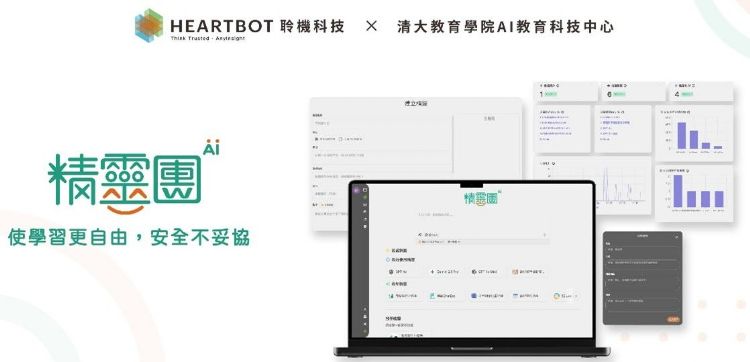
Generative AI is rapidly entering educational settings, yet challenges remain in terms of security and support for Traditional Chinese contexts. The “GenieBench” platform (GenieBench.ai), developed by Heartbot AI, is built around the core principle that “AI can be used safely.” By integrating the TAIDE local language model from the National Center for High-performance Computing (NCHC) under the National Applied Research Laboratories (NARLabs), along with the TAIWAN AI RAP high-performance generative AI application development platform, GenieBench enables teachers to easily build dedicated AI teaching assistants, ushering in new forms of interaction and management in education.
Heartbot AI CEO Yan Tzu-Chiang noted that GenieBench not only helps teachers comprehensively manage information across lesson preparation, in-class interaction, and post-class assignments, but also allows them to monitor and manage student inputs, AI-generated responses, and interaction records. This ensures information security and tracks student learning progress, while reducing concerns related to improper use or ethical risks.
Building a Secure, Inclusive, and Practical Smart Education Platform with a Local Language Model
GenieBench adopts the TAIDE language model developed by NCHC to strengthen its understanding of Traditional Chinese and contextual nuance. Trained on Taiwanese government documents and local datasets, the model generates natural language that aligns with regulations and educational contexts, avoiding issues commonly seen in foreign models such as simplified-character bias or semantic misalignment.
According to Yan, this capability allows GenieBench to better meet real classroom needs, supporting teachers in drafting lesson plans, official documents, and cross-language communications with content tailored to specific purposes. The platform also supports Zhuyin input and Chinese–foreign language translation, facilitating communication between teachers and families of new immigrants, further enhancing inclusivity in AI-powered education.
In addition, GenieBench AI offers a “no-code agent builder,” enabling teachers to quickly create personalized AI teaching assistants—such as reading comprehension helpers, interdisciplinary inquiry partners, or story-creation coaches—using prompts. Leveraging the TAIDE model, teachers can rapidly generate teaching materials, while students interact with AI assistants under secure supervision. The platform also integrates AI classroom management, learning effectiveness analytics, and school administration support modules, significantly reducing teachers’ preparation and administrative workloads.
Since early 2025, GenieBench has been piloted in multiple elementary and secondary schools in Hsinchu City. The curriculum incorporates AI literacy instruction from the College of Education at National Tsing Hua University, allowing students to use AI for interdisciplinary project-based learning, including SDGs explorations and creative writing. Feedback from teachers and students indicates that the platform not only increases learning engagement and creative motivation, but also inspires broader interdisciplinary teaching applications.
Looking ahead, Heartbot AI will continue its collaboration with the AI Education Technology Center at the College of Education, National Tsing Hua University, to advance automated lesson generation and AI-assisted learning applications in STEM fields. GenieBench AI will also maintain close cooperation with NCHC’s TAIDE and RAP platforms, promoting local AI as a trustworthy, long-term partner deeply rooted in educational practice.
Source: Digitimes Technology